10-17-2026



|
Getting your Trinity Audio player ready...
|
The views expressed in this article are those of the author and do not necessarily reflect the position of CoinGeek.
- When Bitcoin stopped changing
- What a settled protocol enables
- The architects of stable foundations
- Standards without the politics
Four blocks.
That is the lifetime output of the chain that was going to save BTC)from spam. BIP110 opened its mandatory signaling window at block 961,632 on August 8, 2026, with miner support under 3%, and the Knots nodes enforcing it rejected the first non-signaling block and walked off to find their destiny… Casa co-founder Jameson Lopp’s post-mortem found who was behind it: “Turns out there was only one tiny entity that called themselves ‘Roughnecks’ who mined the entirety of the 4 blocks on the BIP-110 fork.” Two blocks on the Saturday, two more the next day, and then nothing. bip110.org still insists the activation went off “successfully” and that “Bitcoin is alive albeit low hash-powered after SHA256d mining pools quit the network.” Four blocks!
Meanwhile, on BSV blockchain, the loudest standards conversation is about a wallet interface or novel token protocols built in script, and no matter what people do, nobody will fork anything at the base layer.
Does a fixed base layer end change? No. It moves up a floor, where it is cheap, optional, and competitive, and the two Bitcoins just ran the experiment side by side.
What settled looks like
Something quiet happened on BSV, and quiet is the point. The BRC library exists to be, in its own README’s words, “a platform for sharing ideas without any bureaucratic overhead.” Fork the repo, write a markdown file, open a pull request, argue. The index now holds 187 proposals, and the rule for changing one is that you write a new one that extends it, so nothing already running breaks.
Out of that pile came BRC-100, by Ty Everett, Tone Engel, and Brayden Langley of Project Babbage. Its full title puts the word Unchanging right in the name, and its stated goal is “providing a bedrock foundation atop which anyone can build with confidence, knowing the interface will remain constant.” The promise: “any application can integrate with any compliant wallet without needing custom adaptations.”
Nobody voted on it! It got adopted because it was good. BSV Association shipped reference implementations in @bsv/sdk and wallet-toolbox, plus BSV Desktop and BSV Browser. Babbage ships Metanet Desktop on it. Matt Archbold‘s Hudos Browser runs on it. BEEF transactions, BUMP merkle paths, BRC-42 key derivation, and the 1Sat Ordinals basket profile all snap onto the same interface, and the builders’ conversation has moved to the only question that matters: what do we build on this?
That is what a decade of BTC never had. From 2015 to 2025, the fights were block size, SegWit, flag days, and Knots versus Core, and I covered most of them, every one at the protocol layer, where losing means your node leaves the network.
BTC is still there…
BIP110 produced no settlement, only a purge: on August 9, BIP editor Mark “Murch” Erhardt filed a removal motion saying “this week a new forkcoin spun out of Bitcoin under his leadership,” and about 26 hours later, Knots maintainer Luke Dashjr was gone. Dashjr’s answer on X: “This is just an abuse of power by Core. They have no authority to do so.” I wrote in July that proof of work prices influence out, and a legislature prices it in. The legislature just held its recount.
The men who fixed the floor
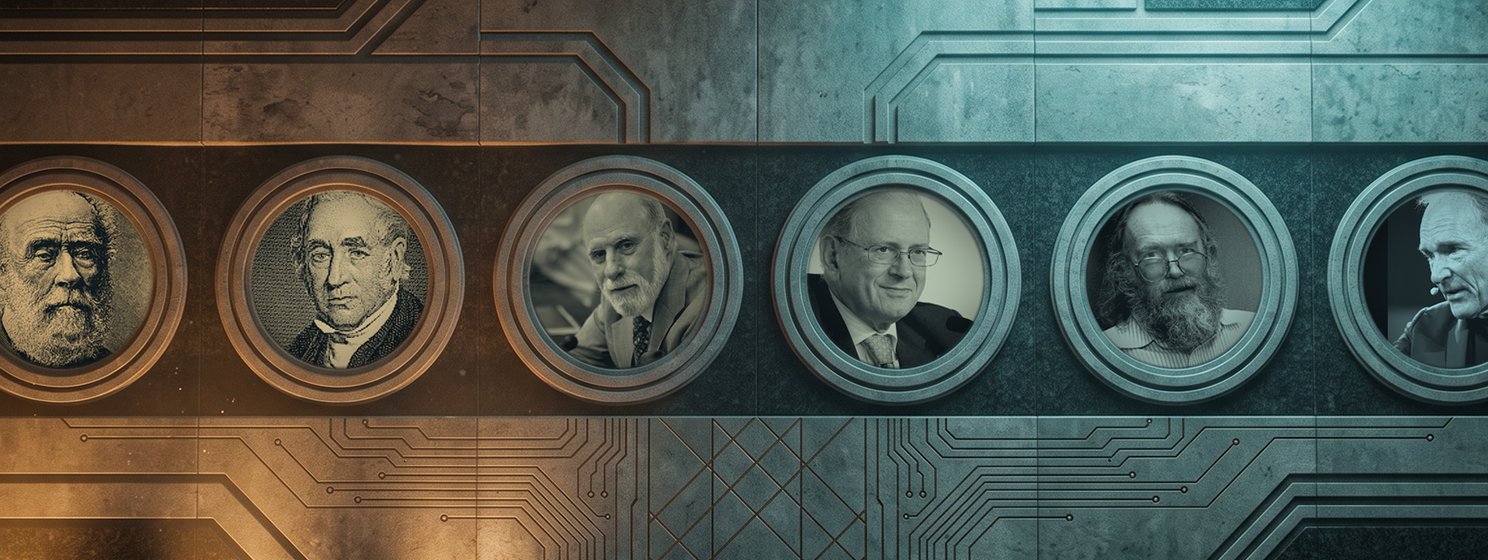
Every great layered technology came from people who nailed the base down and let the world build above it.
Vint Cerf and Bob Kahn published the TCP/IP paper in May 1974 and never patented it. Kahn’s first ground rule for the open architecture, as recorded by the Internet Society: “Each distinct network would have to stand on its own and no internal changes could be required to any such network to connect it to the Internet.” Fix the interface, leave the internals alone. ARPANET had exactly one flag day, January 1, 1983, when NCP went off, and TCP/IP went on, and the Internet has never needed another in over 43 years!
Jon Postel edited the RFCs by hand for decades, and RFC 761, January 1980, carries his law: “be conservative in what you do, be liberal in what you accept from others.” MIT’s David Clark put the whole philosophy on one plenary slide at IETF 24 in July 1992: “We reject: kings, presidents and voting. We believe in: rough consensus and running code.” On April 30, 1993, CERN signed the Web into the public domain, and by late 1993, there were over 500 web servers. Tim Berners-Lee, five years later, in six words: “URIs don’t change: people change them.”
Technologists of a generation ago seemed wise, but the physical world got there earlier. Keith Tantlinger designed the twistlock corner fitting for Malcom McLean’s containers and talked McLean’s Sea-Land into releasing the patents royalty-free, and the ISO container standards followed, starting with ISO 668 in 1968. Joseph Whitworth proposed a uniform screw thread in 1841, William Sellers pitched a better one to the Franklin Institute in 1864, and the Navy and the Pennsylvania Railroad adopted it. The American South regauged about 11,500 miles of track over two days in 1886 so its cars could run on the same rails as the North, within a half-inch of the gauge George Stephenson picked for a colliery tramway.
Nobody has re-litigated the screw thread since. They just build things with it.
Satoshi Nakamoto knew this. On June 17, 2010, he wrote that “once version 0.1 was released, the core design was set in stone for the rest of its lifetime,” and in the next sentence said that is why he built it to support every transaction type he could think of. I made the case for the fixed protocol back in 2020. The part I could only promise back then is now sitting in a GitHub index with 187 entries and a wallet interface that says “Unchanging” on the tin. A seemingly small victory with massive implications.
Isn’t a standards library just governance with a friendlier logo?
No.
A BRC binds nobody. Ignore BRC-100, and you lose interoperability with a few wallets, not your coins, and your node keeps validating the same chain as everyone else. Nobody gets purged from a GitHub repo for shipping a different interface; the market ignores them, which is the correct punishment. Compare BIP110, where the losing side literally left the network, and the winning side then went hunting for the (figurative) head of its editor. That is what a change mechanism does every single time, and I have been writing it down since 2021. Politics eats into any layer where the loser cannot walk away with his coins intact.
Above a fixed base, standards win by being good.
Below it, they win by lobbying and sometimes fixing an election, and Lopp summarized it coldly: “Bitcoin is driven by incentives and game theory, not by morality.”
So build on the settled interface. The BRC repo is open, the wallet-toolbox reference implementation is there, and any app you write against BRC-100 today will talk to every compliant wallet tomorrow without asking anyone’s permission.
The floor is done. Come put something cool on it.
This opinion piece is published to encourage discussion. The author’s views are their own and do not constitute legal, procurement, or policy advice, nor do they represent the positions of CoinGeek or its partners.
Watch: Bitcoin’s Ultimate Use Case Explained