11-04-2026




|
Getting your Trinity Audio player ready...
|
TL;DR: Southeast Asia’s digital economy is projected to hit $368 billion in 2026 and top $1 trillion by 2035, driven by AI and agentic commerce. Singapore and Germany are adding industrial AI to their work plans, the Philippines is pushing digital investment at APEC, and ASEAN’s DEFA digital trade pact is expected in November.
Key Takeaways:
- Southeast Asia’s digital economy is projected to reach $368 billion in 2026, up 17% year-on-year.
- The region’s digital economy is expected to exceed $1 trillion by 2035, driven by agentic commerce.
- Generative AI adoption has reached 243 million people, or 58% of the region’s working population.
- Singapore and Germany are making industrial AI part of a five-pillar work plan on security, trade, and energy.
- The Philippines pushed investment and digital transformation at the 33rd APEC Finance Ministers’ Meeting.
- ASEAN’s DEFA, expected in November 2026, is billed as the world’s first regionwide digital trade pact.
Southeast Asian countries including the Philippines and Singapore are boosting their digital transformation efforts, with Singapore partnering with Germany to make industrial artificial intelligence (AI) as part of their five-pillar work plan, while the Philippines pushes investment and digitalization plans at Asia-Pacific Economic Cooperation (APEC). Meanwhile, a new report found that Southeast Asia’s digital economy is projected to grow by 17% this year.
New report projects SEA’s digital economy to exceed $1 trillion by 2035
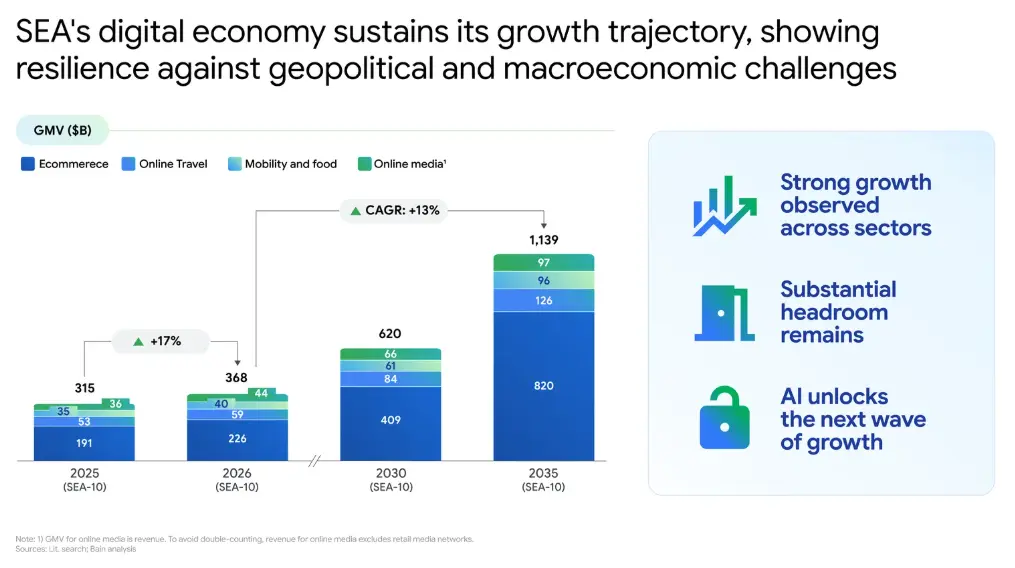
A new report by Google (NASDAQ: GOOGL), Temasek, and Bain & Company revealed that Southeast Asia’s digital economy is projected to grow by 17% year-on-year, reaching $368 billion in Gross Merchandise Value (GMV) in 2026, driven by the rapid adoption of AI.
According to the 11th edition of the annual “e-Conomy SEA 2026” report published on October 21, the Southeast Asian region’s digital economy is expected to exceed $1 trillion by 2035, driven by the growing confidence in agentic commerce. It said that generative AI adoption has reached 243 million people in Southeast Asia, representing 58% of the working population, which it revealed scaled four times faster than mobile internet.
The report examined key trends and the outlook for technology across Southeast Asia’s 10 countries: Indonesia, Malaysia, the Philippines, Singapore, Thailand, Vietnam, Brunei, Cambodia, Laos, and Myanmar.
“Enterprise AI usage is strongest in more mature markets, driving 45% to 60% of usage in Singapore and Malaysia,” Temasek said in a statement. “As people in Southeast Asia move from simple searches to delegating complex tasks to AI agents, demand is projected to surge by up to 60-fold by 2030.”
According to Google’s post on the report, AI is driving growth across the digital economy, online travel, online media, mobility, food delivery, and digital financial services.
To meet the SEA’s projected AI usage by 2030, the SEA 2026 report suggested pushing for agentic AI adoption, scaling AI infrastructure, ensuring model and energy efficiency, and promoting economic sustainability.
“Anchoring this trajectory, the upcoming ASEAN Digital Economy Framework Agreement (DEFA) in November 2026 will establish the world’s first region-wide digital trade pact, providing a framework that can unlock further growth in the Southeast Asia digital economy,” Google added.
Temasek Global Investment Head of Asia Pacific, Fock Wai Hoong, believes AI adoption requires strong governance, disciplined execution, and resilient business models. “Temasek remains committed to the region, investing in businesses with proven models and helping them to create long-term value through our capital, networks, and partnerships,” he said.
Meanwhile, Google’s Managing Director for Southeast Asia and South Asia Frontier Markets, Nitin Gajria, noted that the region has been optimistic about AI due to its proven utility and real productivity.
“As people move from basic queries to trusting AI agents with autonomous tasks, Southeast Asia has a unique window to lead the world in agentic commerce. Unlocking that full potential will require clear governance, transparent capabilities, and an unwavering commitment to responsible AI deployment,” he said.
See the full economy SEA 2026 report here.
Singapore and Germany collaborate to make industrial AI possible
Speaking of AI, Singapore and Germany are collaborating to make industrial AI a part of their five-pillar work plan around security, trade, and energy, Channel News Asia reported on October 27.
At a joint press conference at Parliament House with German Chancellor Friedrich Merz, Singapore Prime Minister Lawrence Wong said that Singapore and Germany recognize the “enormous potential” of digital technologies and AI to revolutionize economies by creating new opportunities for businesses and workers.
“Singapore and Germany may be geographically far apart, but we share many common interests and convictions, and this was very clear from our discussions this morning,” said Wong. “These shared convictions have underpinned our friendship over the past six decades. And in a world that is becoming more uncertain and fragmented, our ties will be even more important in bringing our two countries and our two regions closer together.”
Wong added that both countries “now want to go further” with joint work plans for collaboration in areas such as AI, the digital economy, research, and ASEAN. “Particularly in the development and deployment of industrial AI, where the strengths of our two countries can complement each other,” he said.
“We have to prepare ourselves for a world that is increasingly marked by insecurity, and we have to do so internally and externally. We want to safeguard our prosperity, our competitiveness, and we want to have a say in shaping the major technological revolutions,” said German Chancellor Merz.
Industrial AI is the application of technology to physical operations, robotics, and machinery, such as in manufacturing and logistics systems. Wong said Singapore and Germany will bring their complementary strengths to the project while also recognizing the risks and challenges of AI.
“Even as we cooperate on AI deployment, we will ensure that this is done in a way that remains safe, trusted and human-centered,” he said.
Wong said Singapore is focused on the applications of AI where it has advantages to offer, pushing for deployments of the tech in healthcare, logistics, finance, and advanced manufacturing. Germany, on the other hand, is known for its engineering and industrial craftsmanship.
Speaking about how they’ll work together, Merz said that both Germany and Singapore will pursue AI security through their newly set-up institutions for AI safety and security.
In addition to AI, both nations are looking to integrate their digital systems, citing ASEAN’s Digital Economy Framework Agreement—the first regionwide agreement on digital economy governance covering digital trade, cross-border e-commerce, cybersecurity, digital identity, digital payments, and cross-border data flows.
The Philippines calls for investment and digitalization initiatives at APEC
Elsewhere, the Philippines joined regional financial leaders at the 33rd Asia-Pacific Economic Cooperation (APEC) Finance Ministers’ Meeting (FMM) in Hong Kong on October 20 – 21.
Department of Finance (DOF) International Finance Group (IFG) Undersecretary Joven Balbosa highlighted the country’s push for investment-led growth, the strengthening of project financing to attract greater private investment, and the harnessing of digital transformation for economic growth. Balbosa represented Finance Secretary Frederick Go at the meeting.
“Ultimately, success should not be measured only by financing committed. It should be measured by whether more bankable projects reach implementation and whether investment delivers more reliable, resilient, and inclusive digital connectivity across the region,” Undersecretary Balbosa said.
He also highlighted plans to strengthen household welfare and financial access, including the Philippines’ Social Security System’s Pension Reform Program, as well as initiatives to improve targeted assistance for low-income households, reduce digital transaction costs, and expand access to formal credit for Filipinos.
The meeting ended with the adoption of the 2026 APEC Finance Ministers’ Joint Statement, which reaffirms regional cooperation on fiscal policy, digital infrastructure financing, and access to financial opportunity. The outcomes of the FMM will help shape the APEC Leaders’ Meeting, which will be held at Shenzhen, China, on November 18 – 19, 2026.
FAQs:
How big is Southeast Asia’s digital economy in 2026?
It’s projected to reach $368 billion in gross merchandise value, up 17%, and exceed $1 trillion by 2035, per the annual e-Conomy SEA 2026 report.
How many people in Southeast Asia use generative AI?
243 million people, or 58% of the working population. Adoption scaled four times faster than the mobile internet did.
What is agentic commerce?
It’s when AI agents complete complex tasks for people instead of just answering searches.
What is ASEAN’s DEFA?
The Digital Economy Framework Agreement is set to be the world’s first regionwide digital trade pact, expected to be concluded in November 2026.
What are Singapore and Germany doing on AI?
They’re adding industrial AI, meaning AI in robotics, manufacturing, and logistics, to a five-pillar work plan on security, trade, and energy.
What did the Philippines push at APEC?
At the October 20–21 Finance Ministers’ Meeting, it pushed investment-led growth, stronger project financing, and digital transformation.
When is the 2026 APEC Leaders’ Meeting?
November 18–19, 2026, in Shenzhen, China.
Watch: Blockchain Revolution in Big Banks