10-28-2026




|
Getting your Trinity Audio player ready...
|
TL;DR: NVIDIA CEO Jensen Huang describes artificial intelligence (AI) as a five-layer infrastructure stack running from energy at the bottom to applications at the top. Bitcoin can be understood similarly: proof-of-work supports the network of nodes, which maintains a shared blockchain that supports programmable transactions and applications. The two stacks do different jobs, but they may become increasingly complementary as autonomous AI systems need independently verifiable records of what they did.
Key takeaways:
- Jensen Huang describes AI as a five-layer stack: energy, chips, infrastructure, models, and applications.
- Bitcoin can also be viewed as a five-layer system: proof-of-work, nodes, blockchain, programmable transactions, and applications.
- Autonomous AI creates a growing need to verify identities, permissions, transactions, and system states.
- AI infrastructure turns energy and computation into intelligence, while Bitcoin turns computation and transactions into a shared, verifiable record.
- If machines generate enormous numbers of actions requiring verification, the blockchain beneath them will also need to scale.
NVIDIA (NASDAQ: NVDA) CEO Jensen Huang has a useful way of thinking about artificial intelligence (AI)—he calls it the five-layer cake.
At the bottom is energy. Above that are chips, infrastructure, models, and finally applications.
Huang’s point is that AI shouldn’t be thought of as a single model or application, but as an infrastructure stack in which every layer depends on the layers beneath it.
“Every successful application pulls on every layer beneath it,” Huang wrote in an NVIDIA blog post explaining the model.
Bitcoin can be viewed in much the same way, although its layers are different because they solve distinct problems. However, from the proof-of-work layer at the bottom to the applications built at the top, each layer depends on the ones beneath it.
This comparison becomes more relevant as AI systems become increasingly autonomous.
AI can generate intelligence, and Bitcoin can generate something AI increasingly needs: independently verifiable evidence of what happened.
AI’s five-layer cake
Huang’s AI cake starts at the bottom layer with energy.
Generating intelligence requires electricity. That energy powers the second layer, specialized chips capable of running huge numbers of computations in parallel.
Those chips are then assembled into the third layer—infrastructure. Data centers combine processors, networking, cooling, power systems, and software into what Huang calls “AI factories.”
Above that sit AI models. These turn all that computation into useful intelligence.
Finally, the models support the application layer, where Huang argues most of the economic value is ultimately created.
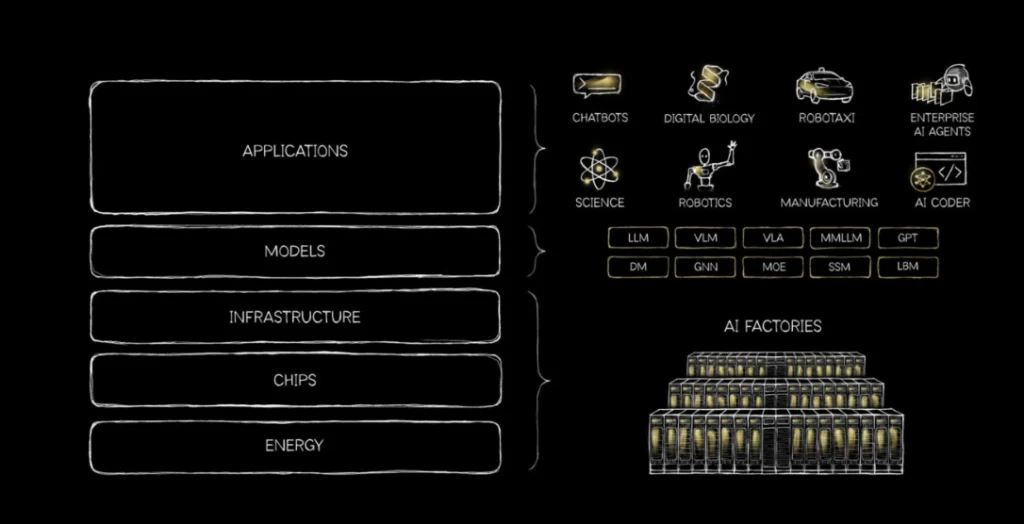
An autonomous vehicle, coding agent, or industrial robot may look like software at the application layer, but none of them can operate without every layer beneath them in the stack.
Bitcoin can be seen as a five-layer cake, too
There is no official Bitcoin specification dividing the system into five layers, and the comparison should not be taken too literally.
However, it’s interesting to note how Bitcoin can also be divided roughly into five layers: proof-of-work, node network, blockchain, transactions and script, and applications. Each layer provides something the layer above needs.
At the foundation is proof of work.
The Bitcoin white paper describes a peer-to-peer network that timestamps transactions by hashing them into an ongoing proof-of-work chain. Producing that proof requires computational resources powered by electricity. In that sense, Bitcoin shares the same physical starting point as Huang’s AI stack: computation ultimately begins with energy.
Above that sits the node network.
Nodes receive transactions, validate them, collect them into blocks, perform proof-of-work, broadcast valid blocks, and extend the chain. In doing so, they establish a common ledger and transaction history.
Their activity produces the third layer: the blockchain, a shared chronological record of transactions.
Above the blockchain is Bitcoin’s transaction and scripting layer.
Bitcoin transactions can contain signatures, locking conditions, hashes, data, and executable Script instructions. Those primitives allow applications to determine who signed something, impose spending conditions, associate records with transactions, and create more complex business logic. BSV has retained and expanded the use of Bitcoin Script for these purposes.
Finally, the application layer sits on top.
Payments are the obvious example, but the same underlying stack can support tokenization, digital identity, cybersecurity, provenance, machine commerce, supply chains, and applications built for autonomous AI agents.
Just as an AI application ultimately depends on electricity, an application on Bitcoin ultimately depends on the proof-of-work network that maintains the underlying record.
The two stacks manufacture different things
Both systems have approximately five layers, but the comparison is much more useful.
While Huang describes AI factories as systems converting electricity into intelligence, Bitcoin converts computation, signatures, and transactions into a shared record that independent parties can verify.
This matters because autonomous AI systems are beginning to act in ways beyond what humans can realistically verify. For example, AI agents can log in to systems, call APIs, authorize transactions, communicate with other agents, alter files, place orders, or spend money within delegated limits.
This raises questions that require honest answers: who acted, and when? On whose authority? What permissions did the system have?, etc.
While AI is increasingly capable of deciding what to do, it doesn’t provide independent, verifiable evidence of what it actually did. That’s where the scalable BSV blockchain can come in.
AI produces intelligence, and Bitcoin produces evidence
The Hugging Face incident highlights how increasingly capable AI systems are beginning to act rather than merely answer questions, but it doesn’t require an ‘incident’ like this to see that AI agents pose verification problems.
Imagine a company that authorizes an AI procurement agent to spend up to $20,000 with approved suppliers. The agent identifies the supplier, negotiates with another agent, agrees on terms, places an order, and makes a payment. This is a snapshot of machine-to-machine commerce in action.
An AI might handle the entire interaction, but both parties still need verifiable answers about identity, authority, agreed terms, spending limits, settlement, and more.
Digital signatures can identify which keys signed transactions, Bitcoin Script can enforce conditions, transactions can record payments and references to agreements, hashes can show whether documents or data have changed, and the blockchain can provide a shared chronological record that isn’t controlled by either party.
In other words, AI can decide what to do, and Bitcoin can determine what was done. Both five-layer cakes can work in tandem.
FAQs:
What are Jensen Huang’s five layers of AI?
NVIDIA CEO Jensen Huang describes AI as a five-layer stack consisting of energy, chips, infrastructure, models, and applications. Each layer depends on the infrastructure below it. Applications sit at the top where the economic value is created.
What are the five layers of Bitcoin?
Bitcoin isn’t officially designated as a five-layer system, but it can be functionally understood as proof of work, the node network, the blockchain, transactions and Script, and the application layer at the top.
What could Bitcoin provide to AI systems?
Bitcoin can provide timestamped transactions, digital signatures, payments, programmable conditions, and cryptographically verifiable records. These capabilities can help establish what autonomous systems were authorized to do and what actions they subsequently took.
Does blockchain tech prove that information is true?
No. A blockchain can prove facts about the record itself, such as whether particular data was committed by a certain time or whether a transaction was signed by a specific key. It can’t independently verify whether a real-world claim entered into a system is true.
Why does blockchain scalability matter for AI?
Autonomous AI systems could generate very large numbers of payments, permissions, audit events, credentials, and other records. If blockchain is used as verification infrastructure for those machines, the ledger needs to process transactions at a scale comparable to the apps using it.
In order for artificial intelligence (AI) to work right within the law and thrive in the face of growing challenges, it needs to integrate an enterprise blockchain system that ensures data input quality and ownership—allowing it to keep data safe while also guaranteeing the immutability of data. Check out CoinGeek’s coverage on this emerging tech to learn more why Enterprise blockchain will be the backbone of AI.
Watch: AI is a double-edged sword