10-12-2026



|
Getting your Trinity Audio player ready...
|
The views expressed in this article are those of the author and do not necessarily reflect the position of CoinGeek.
This post is a guest contribution by Imran Bukhari, founder and CEO, Bluestuff.io. The author founded one of the companies in this map. Apply the same discount to his company’s claims that he applies to everyone else’s.
- Understanding “agentic” in the iGaming landscape
- AI is not the same claim as agentic
- The map categorizing the industry
- Where Bluestuff.io sits
- What’s next
Sometime this year, “agentic” became the most overworked word in iGaming.
A CRM suite is agentic. A support chatbot is agentic. A trading engine is agentic. At least one vendor has claimed the sector’s first “agentic operating system” for customer engagement. I run a company that calls itself the agentic operating system for iGaming, so I’m not throwing stones from outside the glasshouse. I’m standing in the middle of it, suggesting we agree on what the word means before it stops meaning anything.
The industry’s own numbers explain why this matters commercially rather than semantically. Four in five iGaming companies already use artificial intelligence (AI) in some capacity, according to The State of AI in iGaming, a survey by NEXT.io and The Playa of senior decision-makers published in July. Only about one in five report meaningful ROI, per the UNLV International Gaming Institute and KPMG’s State of AI in Gaming 2026, released in April—a report that also put the industry’s average AI maturity at 45 out of 100. That’s not an adoption problem. It’s an execution gap. And “agentic” has become the word every vendor uses to claim they’re the ones who close it.
Some of them are telling the truth. The difficulty is that they’re telling the truth about very different things.
AI is not the same claim as agentic
Start with the company making the strongest autonomous-operations claim in the industry, which—instructively—rarely uses the word.
Kambi’s AI priced and traded 48% of bets across its network in 2025. By Q1 this year, that figure was 60%, and the company committed to running the entire World Cup cycle AI-traded—then processed over 100 million bets during the tournament. That is real autonomy over real money at real scale, and Kambi describes it in plain language: pricing, trading, risk. One function, done with a depth nobody else can currently match.
That’s the clean version of the distinction. AI sophistication describes how well a system performs a task. Agentic describes whether the system does the work—takes an objective, plans, acts across real systems, checks the result—rather than recommending work for a human to do. A brilliant pricing model and an agentic operation are different claims, and the industry keeps blurring them, usually in the direction that flatters the seller.
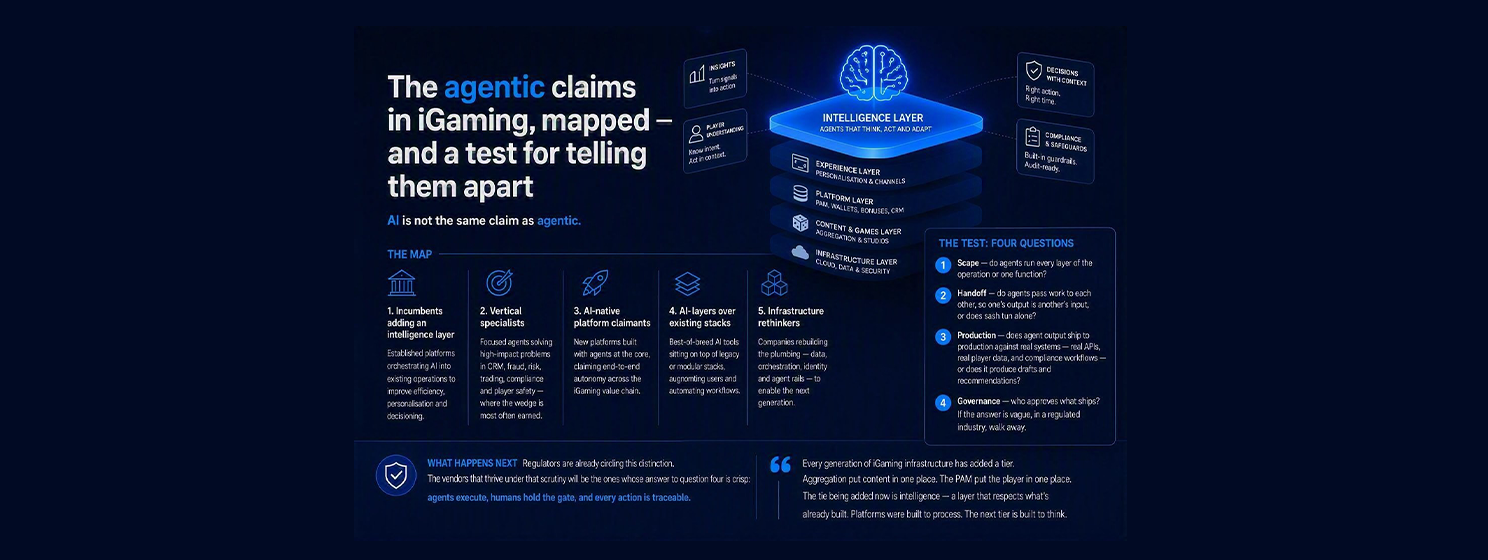
So here is a test—four questions, askable of any vendor using the word—mine included.
- Scope – Do agents run every layer of the operation, or one function?
- Handoff – Do agents pass work to each other, so one’s output is another’s input, or does each run alone?
- Production – Does agent output ship to production against real systems—real APIs, real player data, real compliance workflows—or does it produce drafts and recommendations?
- Governance – Who approves what ships? If the answer is vague, in a regulated industry, walk away.
No question in that list asks how many agents a vendor has. Agent counts are the least informative number in this market—anyone can announce twenty tomorrow. Coverage, handoff, production, and governance are harder to fake.
The map
Run the field through those questions, and it sorts into five groups.
The incumbents are adding an intelligence layer. The established platforms are not standing still. GiG now describes GiG Assistant as “the intelligent command centre of the GiG ecosystem,” uniting its CoreX platform, sportsbook, logic and data products under one AI-driven interface, and quotes partner go-lives in as little as 12–14 weeks across 30+ regulated markets. EveryMatrix, SOFTSWISS, and Soft2Bet are each embedding AI into mature, proven stacks, and SOFTSWISS‘s non-AI velocity (its prediction markets product signed 50+ projects within three months of an April launch) is a reminder that incumbent distribution is its own kind of intelligence. On the test: enormous scope, genuine production, but the AI is largely assistive—a command centre over a conventional platform, with the agentic part still emerging. Kambi sits here too, as the exception that answers question three in one vertical and doesn’t attempt the other three.
The vertical specialists—where the word is most often earned. Fast Track‘s CRM agents genuinely cross the line: an operator describes an outcome and the system plans, segments, builds, and executes the campaign rather than suggesting one. Xtremepush‘s XpertOS makes the boldest framing claim in this group—an “agentic CRM operating system” for regulated engagement, with embedded agents and an approval layer. Optimove is pushing decisioning agents into player journeys. Hey Seven launched in July as an AI-native premium-player development platform, backed by Bettor Capital. AxiumAI is doing context-aware sportsbook engagement, now deployed with ComeOn Group. Machina Sports is building sports-native agent infrastructure for sportsbooks and media. On the test: real handoff, real production—inside one function. The honest description of this group is agentic, vertically. The question a buyer should ask isn’t whether these tools work; several demonstrably do. It’s who coordinates them, and what happens in the seams between one vendor’s agent and another’s.
The AI-native platform claimants. A newer group argues the platform itself should be rebuilt around AI rather than have AI added to it. Elray Gaming (Elray Resources) positions its ELRA Core as an AI-native foundation under a family of products. CloverOS is the most architecturally focused: “your casino, our AI-native stack”—its own PAM, game engine, payments, and back office with named operational agents sitting directly on live platform data. It is casino-only, which is a coherent choice, not a criticism. On the test: the architecture answers questions two and three well in principle; what this group has to prove—and I say this as a member of it—is production evidence at scale, because architecture claims are the easiest kind to make.
The AI layers over existing stacks. Interactive AI sells agents that operate across an operator’s existing PAM, KYC, payments, bonusing, and fraud tooling, with regulator-specific audit exports and policy enforcement on every action—an explicitly compliance-first pitch aimed at operators who will never replatform. This deployment model matters more than any single vendor in it, because it addresses the actual installed base: most platforms fail at AI not because the models are weak but because the estates underneath them are illegible—data unstructured, interfaces closed, business logic buried. A layer that first makes the estate legible, then switches agents on, is the only version of “add AI” that survives contact with a ten-year-old stack.
The infrastructure rethinkers. Openora, the open-source framework Blurify launched in July, attacks the same problem from below: build the platform so agents can understand and modify it. Today, it’s a framework rather than an operation. Long-term, it’s the most interesting architectural bet on this map because if AI-legible platforms become standard, everyone’s agents get better—and the differentiation shifts to who operates them well.
Where my company sits—held to the same standard
Bluestuff.io spans the third and fourth groups: a full-stack AI-native platform for operators launching or consolidating, and the same agent workforce deployed as a layer on top of the platform an operator already runs—their PAM, wallet, and licenses untouched. Agents hand work to each other down a real chain—product to design to build to QA to review—and everything ships through a release gate where humans approve every step that goes live. Nothing ships without operator approval. In a regulated industry, we think that’s a feature to lead with, not a caveat to bury.
Now, the discount I promised. Our headline numbers are company-reported, and you should treat them exactly as you’d treat anyone else’s: a Tier 1 operator running our support agent has 80% of customer-service queries fully automated, a deployment now repeating at other Tier 1s; a full custom sportsbook shipped in 35 days on a Tier 1 crypto operator’s existing platform, not ours. Both true, both ours to prove. The interrogation they deserve—and the one buyers should run on every vendor in this piece—goes beyond the automation percentage: resolution rate, not deflection rate. Escalation rate. How often does a human correct the output? What share of agent-built work actually reaches production? Human hours per deployment. And in this industry above all, how responsible-gambling obligations are handled inside every automated conversation. A support agent that knows the player is also the right place to surface safer-gambling tools—and it should never, under any configuration, encourage play.
One piece of evidence I can offer at full resolution—not because it’s the only one, but because it’s ours, so I can publish every number. One of the operator brands in our own group asked its Tier 1 platform provider for a single localized landing page for an African market—dynamic OTP flows per mobile-money provider, which were breaking affiliate tracking. The quote came back at four months and north of $25,000. The agentic build shipped four localized pages—A/B testing, CMS control, multilingual—in under a week, for less than a third of that quote, working entirely through the platform’s existing APIs. No coordination call required. That gap, not any adjective, is what this category is actually about. The bottleneck in iGaming was never the data. Its execution speed on top of systems that were never designed to be read.
The other thing that separates operating claims from concept claims is unglamorous: regulatory infrastructure. Our platform is GLI certified, connected with seven gaming boards across Africa, with payment networks integrated across 12 countries—and I’ll flag, in the spirit of this piece, that those are company statements; certificates and approvals are the kind of thing serious counterparties should ask to see, and we show them. Any vendor in this map claiming production autonomy in gambling should be able to answer the same question, because a regulator will eventually ask it.
What happens next
Regulators are already circling this exact distinction—the UK Gambling Commission has publicly questioned AI tools that don’t demonstrably deliver, and Malta’s regulator has been consulting on an AI charter. The vendors that thrive under that scrutiny will be the ones whose answer to question four is crisp: agents execute, humans hold the gate, and every action is traceable.
Every generation of iGaming infrastructure has added a tier. Aggregation puts content in one place. The PAM put the player in one place. The tier being added now is intelligence, and the significant thing about this map is that almost nobody on it, my company included, believes it arrives by replatforming the industry one migration at a time. It arrives as a layer that respects what’s already built. Platforms were built to process. The next tier is built to think.
Judge all of us—every company named here—by the four questions. The ones who welcome the test are the ones worth talking to.
About the Author:
Imran Bukhari is the founder and CEO of Bluestuff.io, the agentic operating system for iGaming, developed by NE Group in London. He spent 15+ years in iGaming, including at Bet365.
In order for artificial intelligence (AI) to work right within the law and thrive in the face of growing challenges, it needs to integrate an enterprise blockchain system that ensures data input quality and ownership—allowing it to keep data safe while also guaranteeing the immutability of data. Check out CoinGeek’s coverage on this emerging tech to learn more why Enterprise blockchain will be the backbone of AI.
This opinion piece is published to encourage discussion. The author’s views are their own and do not constitute legal, procurement, or policy advice, nor do they represent the positions of CoinGeek or its partners.
Watch: AI is becoming a game-changer for iGaming