11-23-2026




|
Getting your Trinity Audio player ready...
|
TL;DR: At the ASEAN Business and Investment Summit on November 15, Rappler CEO and Nobel laureate Maria Ressa argued that bots, social media, and AI summaries are pulling readers away from the newsrooms that produce the reporting. She used her talk to introduce her new book and called on business leaders to “fund the facts,” because reliable information underpins contracts, investment, and markets.
Key Takeaways:
- More than half of web traffic comes from bots, and AI search summaries often answer questions before users ever click through to the original outlet.
- Filipinos have led the world in social media time for six straight years and ranked fifth globally in early ChatGPT adoption.
- Ressa’s new book offers a roadmap. It is built around three verbs (understand, defend, and build) with 10 chapters, 10 actions per chapter, and 10 strategic goals.
- Ressa urged companies to shift ad spending back to credible media, push platforms to build in safety, and cooperate across ASEAN.
More than half of web traffic comes from bots. In the Philippines, media network GMA Network’s net income fell 98% in the first nine months of 2026. And when you search on Google (NASDAQ: GOOGL), an AI summary can answer your question before you ever visit the news outlet that did the reporting.
These were among the points Maria Ressa left us with at the ASEAN Business and Investment Summit on November 15. Sitting in the audience, I kept coming back to one line from the Rappler CEO and Nobel Peace Prize laureate: “We’re defending a public square that people no longer walk through.”

As a journalist, I thought about what that means for the work we do. If readers get the information they need without visiting the source, how do newsrooms pay for the next story?
Earlier in her talk, Ressa put the Philippines at the center of the story. She said Filipinos spent the most time on social media for six years in a row and that the country ranked fifth worldwide in early ChatGPT uptake in 2026. She cited a 2018 MIT study on how quickly false news spreads. The researchers found that false stories reached 1,500 people about six times faster than true ones on Twitter (now X).
For Ressa, the consequences were personal.
“I was attacked with 90 hate messages per hour on Facebook in August of 2016,” she said.
Ressa described three waves of technology. Social media competes for our attention. Chatbots can gain our trust through private conversations, sometimes by telling us what we want to hear. And AI agents can act on our behalf. To show what that shift means, she asked us to imagine handing that kind of control to a stranger: “Would you let the person sitting next to you act for you?”
Those questions run through The Fight Back: A Citizen’s Guide to Standing Up to Dictators, published on October 13, 2026. Ressa organizes the book around three verbs: understand, defend, and build. Its 10 chapters end with 10 actions each, and the book closes with 10 strategic goals.
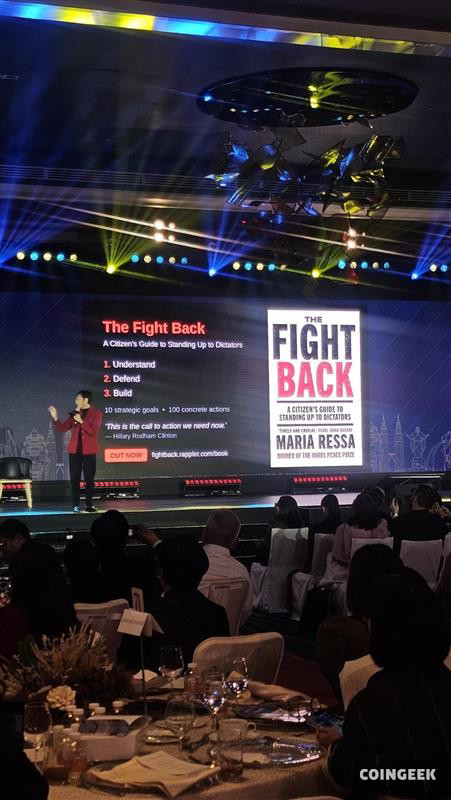
The first three chapters explain what readers are up against. Ressa opens with former Philippine President Rodrigo Duterte and Meta’s (NASDAQ: META) Mark Zuckerberg, whom she calls “The Two Dictators.” She then examines how political strongmen and tech platforms can benefit from the same confusion online, before looking at how chatbots take that influence from the public feed into private conversations.
Chapters four through seven focus on defending yourself, your community, independent journalism, and democratic institutions. The final three ask readers to build their own infrastructure, work across borders on rules for technology and decide what kind of world they want to live in. Ressa pointed to Rappler’s own example, Muni, a platform where readers can speak directly with journalists and one another.

“Fund the facts,” Ressa told the business leaders in the room. She asked them to move advertising money back to credible media, demand that platforms build safety into their products and work together across ASEAN. She made a strong point: businesses depend on reliable information too; investors need numbers they can verify; and companies need to trust the agreements they sign.
She stressed that “without that shared reality, my dear business friends, you have no contracts, no investment, and no markets.”
FAQs:
What is Maria Ressa’s new book about?
The Fight Back: A Citizen’s Guide to Standing Up to Dictators explains how strongmen and tech platforms exploit online confusion, and gives readers concrete steps to defend themselves and build alternatives.
What did Ressa mean by “fund the facts”?
She asked businesses to redirect advertising money to credible news outlets so journalism can stay financially viable.
Why does AI search hurt newsrooms?
AI summaries give readers answers without sending them to the original source, cutting the traffic that newsrooms rely on for revenue.
What is Muni?
Muni is a Rappler platform where readers can talk directly with journalists and with one another.
In order for artificial intelligence (AI) to work right within the law and thrive in the face of growing challenges, it needs to integrate an enterprise blockchain system that ensures data input quality and ownership—allowing it to keep data safe while also guaranteeing the immutability of data. Check out CoinGeek’s coverage on this emerging tech to learn more why Enterprise blockchain will be the backbone of AI.
Watch | DigiCon 2026: Interoperability starts with people