10-15-2026




|
Getting your Trinity Audio player ready...
|
TL;DR: The Middle East is confronting a more complex cyber threat environment, as criminal groups and politically motivated actors use evolving technologies to target organizations, governments, and critical systems.
Key Takeaways:
- Cyber threats are intensifying as digital advances create more opportunities for attackers to target organizations and systems across the Middle East.
- Financial crime remains widespread in the Middle East, with ransomware, fraud, and theft accounting for a significant share of cyberattacks across the region.
- Attack motives are becoming more diverse as cyber campaigns increasingly target political objectives, sensitive information, and critical systems.
Advanced technologies have made it easier for bad actors to infiltrate even one of the most developed regions in the world, the Middle East, with the digital risk monitoring platform CloudSEK releasing a report of the territory’s cyber threat landscape and the contributing factors behind this growing problem.
In its Middle East Cyber Threat Landscape 2025-2026 analysis released on September 16, CloudSEK stated that the region is grappling with rising cybercrime activity, identifying ransomware as the most common form of cyberattack, along with other financially motivated crimes such as fraud and theft.
The AI-powered monitoring platform said the Middle East is experiencing a shift in its cyber threat landscape with the evolution of cyberattack patterns and the emergence of new types of cyber intrusions that are meant to promote a political cause, spark a protest, or steal government and other sensitive information to drive massive disruption across national systems.
Ransomware’s slow burn creeps up as hacktivism dies down
The Middle East is a haven of natural resources, specifically oil and gas, and a known critical trade corridor globally, with the Straits of Hormuz and Bab el-Mandeb as two of its most vital maritime chokepoints. But the escalating military conflict involving Israel, Iran, and the United States is not only causing divisions among countries in the region but also driving cybercrime activity to a whole new level.
According to CloudSEK’s collated data between April 2025 and August 2026, the ongoing geopolitical tensions have contributed to a rise in hacktivism, a form of cyberattack that promotes political, social, and ideological agendas, with Israel named as the primary target, accounting for 37.8% of regional hacktivist activity. The countries of Iran, Türkiye, the United Arab Emirates, and Saudi Arabia, respectively, also made it into the top 5 list of Middle East countries targeted by hacktivisim.
Hacktivist activities proliferated at the height of the regional conflict in 2025—around June and October—before plateauing in April 2026. The CloudSEK report named SKYNET, HeziRash, and DieNet as the top threat actors, which were found to have executed numerous distributed denial-of-service (DDoS) attacks, website defacements, data leaks, and the insertion of malicious SQL code in websites and applications.
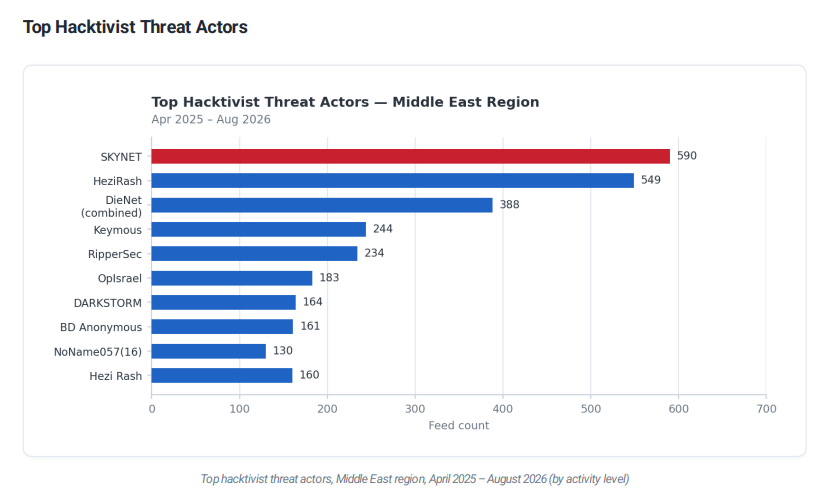
But while hacktivism in the Middle East has simmered down, regional authorities are now met with increasing ransomware attacks in the region.
Ransomware isn’t entirely new in the Middle East, with officials registering several cases in previous years. But what alerted authorities to this threat is its sudden upward trajectory in a short span of time.
Based on recent findings, the Middle East recorded an increase in ransomware activity indicators within the 17-month period, with the most dramatic spike registered in June 2026 at 357, a more than 20-fold surge from 17 activity signals in April 2025. The region’s Facility Management sector dealt the biggest blow from ransomware attacks, while the Industrial, Property Management, Infrastructure, and Manufacturing sectors followed closely.
While Iran can easily be perceived as a target of ransomware attacks, CloudSEK said that the country is more of a source of threat actors than a victim. Türkiye was identified as the most ransomware-targeted country in the region, followed by Israel, the UAE, Egypt, and Saudi Arabia.
The majority of the reported extortion was conducted by the groups Nova, Handala, and Qilin, with their operations, apart from ransomware, centered on payment card theft, botnet, phishing, data encryption, and CAPTCHA-based theft, among others.
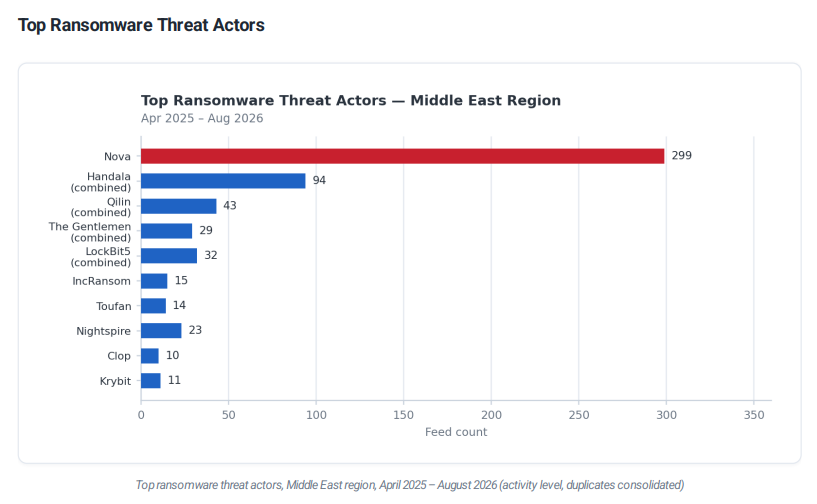
AI, darknet weaves expanding crime web
But cybercrime in the Middle East has gotten deeper, with authorities recording heightened criminal activity in the dark web, where financial services and government agencies identified to be the most targeted victims, alongside e-commerce, banking, investment, retail, telecommunications, and even education.
“This profile is consistent with criminal market demand, financial sector data commands premium prices on underground forums, and government entity breaches attract both criminal buyers and nation-state-sponsored actors,” CloudSEK stated.
The dark web, often called the darknet, is a burgeoning marketplace for bad actors where stolen data are being sold, illicit goods are traded, and cybercrime services are offered.
According to CloudSEK, Türkiye recorded the highest level of darknet activity in the 17-month period, followed by the UAE. Meanwhile, Israel ranked third in dark web activity but topped the list of Middle Eastern countries for overall cyberattack activity, with 7,112 threat intelligence feeds.
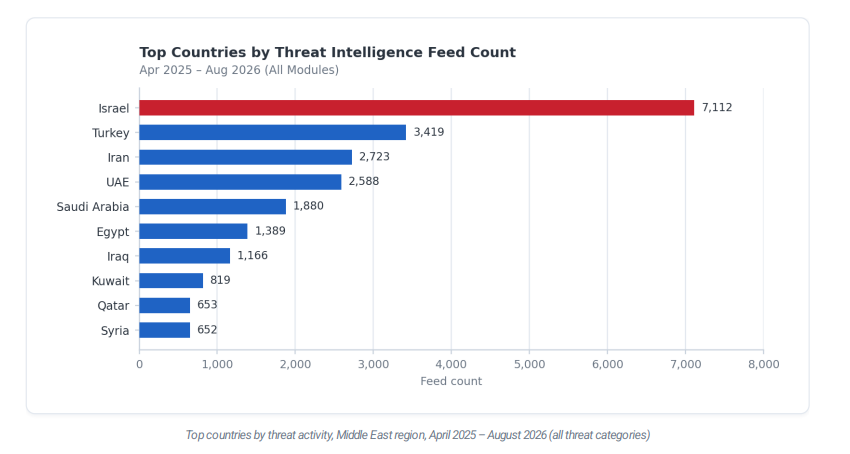
While dismantling criminal organizations on the dark web has become a headache for governments, authorities have had to double down their efforts as bad actors now get support from artificial intelligence (AI), which makes attacks faster and harder to detect, making them more damaging.
Cybercriminals nowadays are resorting to AI tools and applications in executing their attacks as they are generally cheaper than hiring large teams of skilled hackers.
“AI is now influencing almost every stage of a cyberattack,” Ram Narayanan, Middle East country manager at Israeli cybersecurity firm Check Point Software Technologies, told Rest of World in a separate report. “The biggest change is speed. In some cases, the time between a vulnerability being disclosed and attackers trying to exploit it has fallen from days to just hours.”
But countries are fighting back with the same technology; among them is the UAE, which recently introduced its V7 cybersecurity model that detects malware, identifies vulnerabilities, and supports penetration testing activities. This is on top of the federation’s ongoing effort to reskill and upskill its people to support cyber resiliency and the growth of its digital economy, the Computer Weekly reported.
Although AI is widely considered one of humanity’s most powerful technologies, reinforcing one’s cyber resilience does not rest solely in its hands.
Powering up cyber resilience
With recent reports about more than 10% possibility of AI killing all humans, according to a top safety researcher at Anthropic, and Google’s (NASDAQ: GOOGL) AI model Gemini autonomously hacking three companies during a security test, it’s natural for organizations and enterprises to be concerned about the risks posed by increasingly capable AI systems.
But the way to move forward with this is not to halt AI adoption, but to strengthen cyber resilience through investing in threat monitoring, robust identity and access controls, conducting regular security testing, and offering skills training to employees. CloudSEK also recommended that companies implement immutable, offline backups for critical networks and infrastructure.
This need for resilience is particularly pressing in the Middle East, where financially motivated cyberattacks and state-sponsored operations are increasingly converging on the same critical sectors.
As the threat landscape continues to evolve, organizations that take a proactive, layered approach to cybersecurity can remain prepared to defend their operations without holding back from innovating with newer, more advanced technologies.
FAQs:
What are the most common cyber threats in the Middle East?
Ransomware remains a major threat, while fraud, data theft, and hacktivism are also contributing to the region’s evolving cyber risk landscape.
Why is the Middle East facing a growing cyber threat?
The region’s expanding digital infrastructure and the increasing sophistication of technology are creating more opportunities for cybercriminals and other malicious actors.
Which sectors are most targeted by cybercriminals in the Middle East?
Financial services and government agencies are among the most targeted, alongside e-commerce, banking, investment, retail, telecommunications, and education.
How can organizations prepare for evolving cyber threats?
Organizations can build greater resilience by combining continuous threat monitoring, strong identity and access controls, regular security testing, employee training, and offline backups for critical systems.
Watch: Building the tech of tomorrow with blockchain and AI