11-17-2026



|
Getting your Trinity Audio player ready...
|
TL;DR: Developer Andy Rowe has launched solo.bsv.cx, a public “solo pool” for BSV that lets anyone with a Stratum-compatible miner take a shot at winning a full block without running their own node. If your machine finds the block, the entire 3.125 BSV subsidy is minted directly to your address; the service keeps only that block’s transaction fees. The pool found its first block on October 23, and it supports everything from full-size ASIC rigs down to tiny ESP32 hobby boards.
Key Takeaways:
- solo.bsv.cx is a solo mining pool: it does the node and block-template work, but if YOUR miner finds the block, you keep the whole subsidy, paid directly to your address in the coinbase transaction
- No accounts or signups: the login is simply your BSV payout address
- The pool’s only cut is the transaction fees from blocks its miners find, in a separate coinbase output.
- First block already won: #972368 on October 23, 2026, paying 3.125 BSV straight to the finder (verified on-chain)
- Hardware can range from an Antminer S19 to a $30 NerdMiner hobby board; difficulty adjusts based on the connection.
- High variance by design: you could wait weeks between blocks, or hit one tomorrow.
Most people who follow Bitcoin have heard of solo mining and mining pools, and understand the trade-off for each: mine alone and you keep an entire block’s reward (if you ever find one), or join a pool and get small steady payouts for your share of the work. A new service from bsv.cx developer Andy Rowe offers a third option that combines the two, and it has already paid out its first winner.
solo.bsv.cx is different. It’s a “solo pool” for BSV. Like a regular pool, it handles the heavy infrastructure like running the BSV node, building block templates, and feeding work to your mining hardware. Unlike a regular pool, there is no splitting of rewards. If your machine is the one that finds a block, the full 3.125 BSV subsidy is created in that block’s coinbase transaction and paid directly to your own address. The service never holds or redistributes anyone’s earnings. Its only revenue is the transaction fees from blocks its miners win, which go to a separate output in the same coinbase.
“I started a solo pool after hunting for a good one for a couple of years,” Rowe told CoinGeek. He said the existing solo services he tried “seem to mine empty or near empty blocks regardless of how big the mempool grows,” which for BSV defeats the purpose, so he built his own.
All you need is a miner and an address
Connecting is about as simple as solo mining gets. Point any Stratum V1-compatible miner at stratum.bsv.cx:3333, and use your BSV payout address as the login, with an optional worker name tacked on. There’s no password, no account, and no signup form. The pool talks to the BSV network through a bridge built natively on the SV Node software’s GetMiningCandidate interface, with support for version-rolling (AsicBoost) and per-connection variable difficulty that adjusts automatically to whatever hardware you attach.
That last part matters more than it might sound, because the hardware question has two very different answers depending on your goals.
At the serious end, we’re talking about standard ASIC machines. Rowe said he’s mined on and off since 2014, and still keeps an Antminer S19 running at about 105 TH/s, “mostly for nostalgia and experimenting.” He still owns his first Antminer S1 from back then. “Hashrate is another important form of Bitcoin sovereignty that I’m loathe to let go regardless of the profitability of mining,” he added.
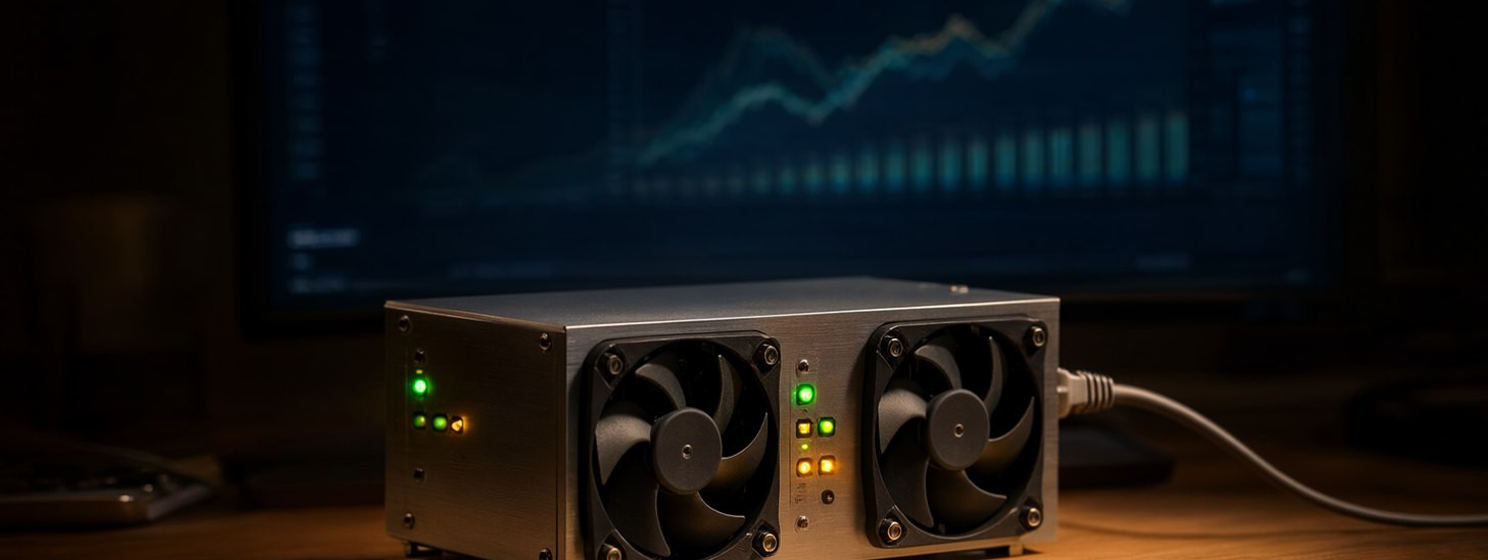
At the “fun end,” the pool added support just this week for NerdMiners, the tiny ESP32-based boards hobbyists run on their desks. “The chances of finding a block with one of them is quite low, but I think they’re still fun and educational so I was happy to put in a bit of work to accommodate them,” Rowe said. “It was worth tweaking vardiff (variable difficulty) so that big rigs and tiny ones are all served appropriate work so that shares land at a predictable rate.”
Why take the gamble?
So why mine solo at all, when shared pools offer steady payouts? Rowe still recommends the established option: “GorillaPool is a great traditional pool, and I recommend them to most miners, but the PPLNS/PPS pools aren’t exciting to me. I’ve always been a bit of a risk taker, and the biggest bonus is getting to write whatever scriptsig I choose for the coinbase tx for a new block.”
That scriptsig privilege is on display in the pool’s first win, block #972368, found on October 23 by Rowe’s own Antminer S19: the same machine he keeps running “mostly for nostalgia and experimenting” took the pool’s first prize. Its coinbase carries the message: “verify, don’t trust ↠bsv.cx 🌙 TANSTAAFL ↑ we escaped Plato’s cave!”
“The scriptsig for the first block our solo pool solved includes a nod to my favorite book by Robert A. Heinlein, The Moon is a Harsh Mistress,” Rowe said. (TANSTAAFL, “there ain’t no such thing as a free lunch,” is the book’s signature acronym.)
For now, the coinbase message is set at the pool level, but Rowe said he is considering allowing miners to append their own messages to the end of their scriptsigs. “That is a griefing vector and needs some sanity checking,” he said. “My to-do list is growing faster than my productivity!”
We verified the payout on-chain: the block’s coinbase minted the full 3.125 BSV subsidy directly to the finder’s address, while the roughly 0.02 BSV in transaction fees from the block’s 9,957 transactions went to a separate output.
The odds are also more reasonable than lottery-style mining on larger networks. BSV’s network hashrate currently sits around 218 PH/s, which means a 105 TH/s rig like Rowe’s would statistically expect to find a block about once every two weeks. Expectation is not a promise, though. Solo mining is inherently high-variance, and the pool’s live stats page tracks the current “effort” percentage so miners can see how the search is going. A wait could stretch to months, or end within hours.
Early days, honest limits
Rowe is open about the service’s youth. “So far we’ve had a few miners test out our solo pool off and on, I suspect testing it as a suitable backup pool. We’ve spiked to 4 PH/s and 500 TH/s intermittently,” he said. The pool currently runs on a single node with no failover, a limitation stated openly on the site, with a second node for redundancy planned.
It’s the third project we’ve covered from Rowe under the bsv.cx banner (by now we could almost call it a brand). The first was an on-chain notary service with the same account-free philosophy, and the second was BRC-166, a formal standards proposal spelling out how AI agents and scripts can pay for web services in satoshis. The solo pool follows the same pattern: minimal accounts, minimal custody, and infrastructure anyone can just point at and use.
The live stats dashboard is at: https://solo.bsv.cx/
Miners can connect to stratum.bsv.cx:3333 at any time. For those who decide the variance isn’t their thing, the site itself recommends GorillaPool (stratum+tcp://bsv.gorillapool.io:3333, PPLNS, ~2% fee) as the steadier shared-payout alternative, which also suggests how Rowe sees the service: not intended as a competitor to the pools, but a different game entirely.
FAQs:
What is a solo mining pool?
A solo mining pool provides the node infrastructure and block templates of a regular mining pool, but does not split rewards. If your own miner finds a block, you receive the entire block subsidy directly. It’s “pooled” only in the sense of shared infrastructure, not shared payouts.
How is solo.bsv.cx different from a regular BSV mining pool?
Regular pools like GorillaPool combine everyone’s hashrate and split rewards proportionally, resulting in small, steady payouts. With solo.bsv.cx, rewards are never pooled: the miner whose machine finds the block gets the full 3.125 BSV subsidy paid straight to their own address.
What hardware do I need to solo mine BSV?
Any Stratum V1-compatible miner works. Serious attempts use ASIC machines like the Antminer S19 (around 105 TH/s), but the pool also supports tiny ESP32-based NerdMiner hobby boards after a recent update. Variable difficulty adjusts to whatever you connect.
How often can a small miner expect to find a BSV block?
At the current network hashrate of roughly 218 PH/s, a 105 TH/s rig would statistically average one block about every two weeks. Actual results vary wildly in either direction, which is the nature of solo mining.
What does solo.bsv.cx charge?
There is no percentage fee on block rewards. The service keeps only the transaction fees from blocks its miners find, paid to a separate output in the coinbase. The full subsidy always goes directly to the finding miner.
Do I need to run my own BSV node to use solo.bsv.cx?
No. The pool runs the node and connects to the network via SV Node’s GetMiningCandidate interface. You only need a miner and a BSV payout address, which doubles as your login.
Watch: Meet the People Shaping BSV Blockchain