10-19-2026




|
Getting your Trinity Audio player ready...
|
Remittances across the globe are increasing steadily amid the ongoing U.S.-Iran war, with Mexico‘s remittances growing by 3% in July. Elsewhere, Bangladesh saw its remittances soar to 22.49% in August, while in Southeast Asia, a report stated that remittances fail to shield the Philippine peso.
- Philippine peso tumbles 7% despite record remittance inflows
- Bangladesh sees 22% remittance growth amid U.S.-Iran war
- Mexico sees 3% remittance growth to $5.57 billion in July
Philippine peso falls 7% despite remittances generating $36 billion
Remittances from Overseas Filipino Workers (OFWs) are no longer enough to shield the Philippine peso from mounting external pressures—such as the oil crisis resulting from U.S.-Iran conflict and global inflation—with the currency falling to record lows as a strong U.S. dollar, capital outflows, widening trade deficits, and higher energy costs weigh on the economy, the Business Times reported on August 31.
The latest balance of payments data compiled by the Philippines’ central bank, Bangko Sentral ng Pilipinas (BSP), shows the scale of the pressure on the Philippine peso. Despite receiving about $17 billion in remittances in the first half of the year, the Philippines recorded a $5.3 billion balance-of-payments shortfall in the first seven months, driven by a $30.8 billion trade gap and net portfolio outflows.
Ruben Carlo Asuncion, Chief Economist at Union Bank of the Philippines, told The Business Times that while remittances could help volatility and underpin domestic consumption, they “cannot fully insulate the peso from global market forces.”
“Given their scale, stability and resilience, remittances will remain difficult to replace as a source of foreign exchange in the foreseeable future,” he added.
Since the onset of the U.S.-Iran conflict earlier this year, the Philippine peso has become one of Asia’s worst-performing currencies, falling by 7% since the war started on February 28.
According to Japanese lender MUFG Bank (NASDAQ: MUFG), the Philippine peso’s underperformance resulted from the persistent pressure on the country’s external accounts. On August 28, the Philippine peso closed at PHP 62.2 per U.S. dollar, sinking past its previous historic low of PHP 61.8 ($.99) a day earlier.
Gross International Reserves—the BSP’s foreign-currency buffer to defend the peso and pay for imports—fell to $103.3 billion in July, covering 6.7 months of imports.
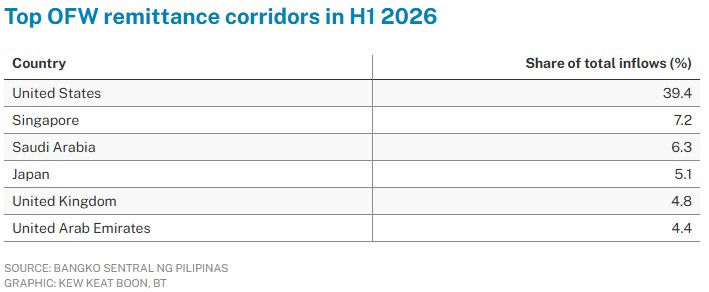
OFW remittances have long been a shock absorber during events when the peso weakens, The Business Times said. According to their data, the U.S. remains the primary source of remittances, accounting to 39.4% of total transfers, followed by Singapore at 7.2% and Saudi Arabia at 6.3%.
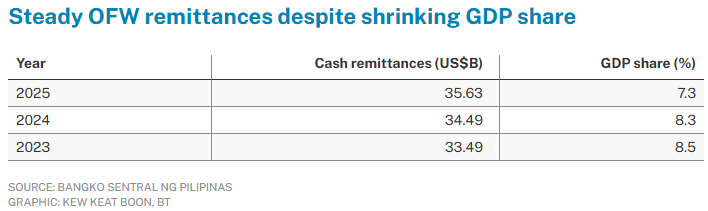
Despite OFWs’ money transfers rising to an all-time high of $35.6 billion in 2025, accounting for 7.3% of gross domestic product (GDP), this remains the lowest share in 25 years.
Asuncion also explained that the declining share of GDP from remittances may reflect a “more diversified” economy.
Bangladesh: Remittances inflow rises to 22% in August
In South Asia, remittances in the People’s Republic of Bangladesh rose to 22.49% in August, or $2.96 billion, marking the third consecutive month of inflows that stayed below the $3 billion mark.
According to officials at the Bangladesh Bank—the nation’s central bank—inflows were below $3 billion from June due to the impact of the U.S.-Iran war.
The majority of the Bangladeshi migrant workers are based in the Middle East, one of the regions most affected by the war. In August, the central bank’s data showed that Islami Bank received the highest amount of remittance at $550 million and was followed by Bangladesh Krishi Bank at $292 million, BRAC Bank at $235 million, and Trust Bank at $211 million.
According to Mati Ul Hasan, managing director of Mercantile Bank, the remittance inflows are lower than expected since the Middle East is still experiencing a slowdown in development activities. Manpower is limited to many countries, and some workers are already returning home, he added, as reported by The Daily Star.
Additionally, data from the Bureau of Manpower, Employment and Training revealed that 9.69 lakh people left Bangladesh for overseas jobs last fiscal year, down from 5% year-on-year.
Remittances in Mexico grew 3% in July to $5.57 billion
On a more positive note, family remittances sent from Mexico reached $5.571 billion in July 2026, up 3% year-over-year, marking the sixth consecutive month of annual growth, according to official financial data from the country’s central bank, Banco de México (Banxico).
In July, Banxico has registered 13.1 million individual cross-border transactions, primarily originating from senders in the United States. While transaction counts showed no growth, the average transfer value per order rose 3% year-over-year to $426 per shipment.
In the first half of 2026, cumulative family remittances grew 3.1% year-over-year to $30.759 billion, an increase of $197 million from the $29.842 billion figure in the first half of 2025. Overall, the average remittance payment received in Mexico for the six months rose 5% from $386 per transaction in 1H25 to $405 per transaction in 1H26.
Despite steady growth, bank-based electronic transfers still dominate cross-border money transactions in Mexico, accounting for 99.2% of inbound transactions, while remittances totaled $107 million, down 5.4% from a year earlier.
Remittance inflows gained further traction in June 2026, with monthly remittance inflows reaching $5.472 billion. This represented a 4.1% year-over-year growth rate and a 3.8% sequential increase compared with May 2026 data. By June, Banxico registered 12.9 million individual transactions, reflecting a 4.2% annual rise in transaction count, while the average transfer value rose 3.8% year-over-year to $422 per transaction.
BBVA Mexico analysts linked the positive growth to the strengthening labor market conditions for Mexican workers in the United States.
Labor force participation among documented and undocumented Mexican migrants increased from 65.8% in November 2025 to 66.3% in May 2026. The migrant unemployment rate also fell to 3.9% in May, improving household disposable income in short-term and part-time occupations.
Watch | Philippine Blockchain Week 2026: What’s Working Now?